
Agricultural water systems must move a variable resource from wells or reservoirs through pumps, treatment equipment and distribution networks—often across remote sites and difficult operating environments. Continuous level and pressure information gives operators the visibility needed to manage that journey: protecting pumps from low-water conditions, confirming discharge pressure, maintaining irrigation-system pressure and identifying developing filtration restrictions. Well-performance analysis itself commonly relies on pumping water level, discharge flow, discharge pressure and input power.
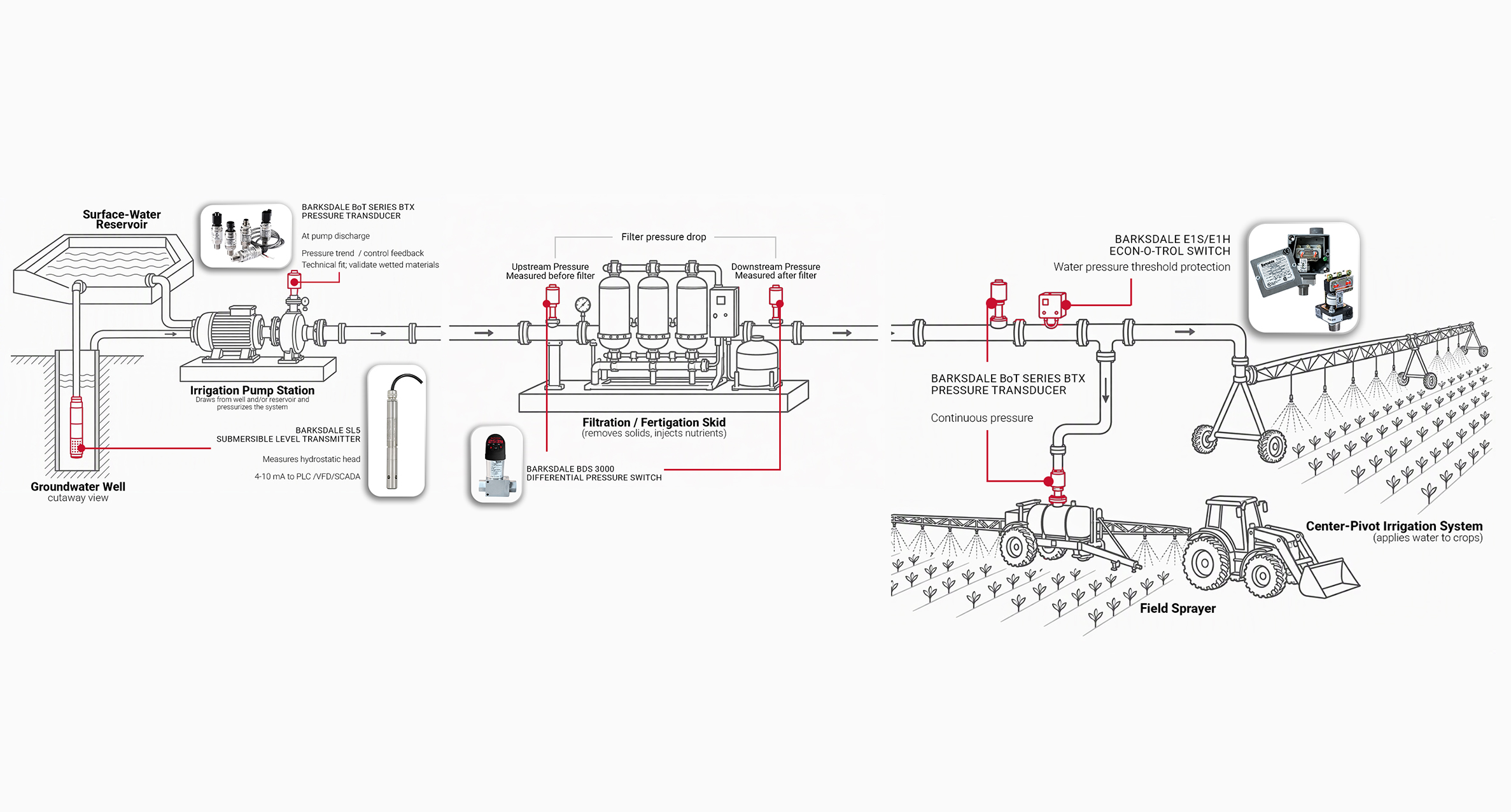
Barksdale’s agriculture-relevant portfolio includes the SL5 Submersible Level Transmitter, BoT Series BTX pressure transducers, and E1S/E1H Econ-O-Trol pressure switches. The following architecture shows how these products can be applied from the water source to the irrigation equipment.
Figure 1: Representative agriculture sensing architecture from water source through pumping, treatment, and center-pivot distribution.
The Challenge
A representative global agricultural operation may draw from a groundwater well, surface reservoir or storage tank. The available water level changes with pumping, recharge, weather and seasonal demand. If a well is overdrawn, insufficient water around the pump can contribute to motor overheating, cavitation and pump damage; continuous monitoring also helps distinguish standing water level from pumping water level.
Once water reaches the pump station, operating pressure becomes another essential indicator. The irrigation system needs enough pressure to move water through filtration, elevation changes, pipe losses, regulators and emitters.
The sensing equipment must also tolerate outdoor temperature changes, moisture, pressure cycling, electrical noise and—in some systems—water hammer or freeze-thaw exposure. Product selections therefore need to be based on pressure range, media chemistry, required output, enclosure protection, installation geometry and environmental validation rather than application name alone.
The Barksdale Solution
1. Establish continuous visibility at the well or reservoir
A Barksdale SL5 Submersible Level Transmitter is suspended below the water surface. It measures hydrostatic pressure from the water column and converts that measurement into a continuous 4–20 mA signal for a PLC, VFD or SCADA system.
The SL5 is documented for groundwater monitoring, agricultural irrigation systems, storage tanks and surface-water monitoring. Verified specifications include:
- 0–500 psi measurement capability, corresponding to as much as 1,150 ft / 350 m of water, configuration dependent.
- ±0.25% FSO accuracy at 25°C.
- 4–20 mA loop-powered output and 8–33 VDC supply.
- IP68, all-316L-stainless-steel wetted construction and polyurethane-jacketed cable.
- –40 to 176°F / –40 to 80°C operating range.
- 0.75-inch diameter for installation in 1-inch Schedule 80 or Schedule 120 PVC.
- A field-replaceable sensor, removable nose cone and cable lengths up to 1,300 ft / 400 m.
For the operator, the practical value is continuous source-level visibility without relying solely on manual readings. The replaceable sensing module also allows the installed cable to be reused when appropriate, addressing a major maintenance-cost driver in deep-well installations.
Explore Continuous Water-Level Monitoring
Review the Barksdale SL5 for groundwater wells, reservoirs and agricultural water-storage applications.
2. Monitor pump discharge pressure
A BoT Series BTX pressure transducer installed at the pump outlet provides continuous pressure feedback. That signal can be used for trending, control-system feedback and identification of pressure behavior that warrants investigation.
Relevant BTX capabilities include:
- Piezoresistive and welded versions with ±0.25% FSO typical accuracy; ceramic and monolithic versions are typically ±0.5% FSO.
- Outputs including 4–20 mA, 0.5–4.5 V ratiometric, 1–5 V and 0–10 V.
- Configurable pressure ranges including common irrigation ranges of 0–50, 0–60, 0–100 and 0–150 psi.
- –40 to 212°F / –40 to 100°C ambient operation.
- IP67 on applicable electrical configurations.
- Stainless-steel construction, multiple NPT, SAE, metric and G-thread connections, and M12, DIN, Deutsch, cable and vehicle-style electrical options.
- Resistance to 15 g vibration and 50 g shock.
3. Track pressure through filtration and fertigation equipment
Where the irrigation system includes filters, measuring pressure upstream and downstream allows the control system to calculate pressure drop. Increasing differential pressure can indicate accumulating restriction, while an unexpected pressure change may point to leakage or abnormal flow conditions.
Two technically supportable Barksdale approaches are:
- Two BoT Series BTX transducers, one upstream and one downstream, where the control system calculates the difference.
- A BDS3000 electronic differential-pressure switch where the required range, materials, process connections and environmental ratings match the skid. The BDS3000 is documented with differential ranges up to 500 psid, two switch points, analog output and IO-Link options.
4. Maintain pressure awareness across center-pivot irrigation
At the center pivot, the BoT Series BTX provides continuous pressure data to the machine controller. The BTX’s output and connection choices also allow it to be matched to the OEM control architecture.
For systems requiring a discrete threshold response, the E1S/E1H Econ-O-Trol provides complementary mechanical switching with 1,000 psi proof-pressure test, adjustable or factory-set switching, and NEMA 4/IP65 housed configurations.
Used together:
- BTX supplies continuous pressure information for display, automation, diagnostics or remote monitoring.
- E1S/E1H supplies a straightforward electrical response when pressure crosses a selected threshold.
Compare Continuous and Threshold Pressure Sensing
Explore continuous pressure feedback with the BoT Series BTX and discrete threshold protection with the E1S/E1H Econ-O-Trol.
5. Mobile agricultural equipment
Pressure measurement is relevant to:
- Spray-bar pressure, where pressure is associated with controlled delivery of fertilizer or crop-protection fluid.
- Boom hydraulic pressure, used by machine-control systems supporting boom position or actuation.
- Tractor and implement hydraulics, including main and auxiliary pump circuits.
- Pneumatic planter systems, where air pressure supports control of planting-system force or depth.
Application-to-Product Mapping
| Application | Measurement point and challenge | Barksdale family/model | Customer value |
|---|---|---|---|
| Well, borehole and groundwater level | Hydrostatic pressure below water surface; changing source level and remote access | SL5 Submersible Level Transmitter | Continuous 4–20 mA level data; IP68/316L construction; field-replaceable sensor |
| Reservoir and agricultural water storage | Water-column level for inventory and pump control | SL5 | Continuous monitoring, VFD/PLC/SCADA integration and reusable cable architecture |
| Irrigation-pump outlet | Continuous discharge pressure and abnormal-pressure visibility | BoT Series BTX | Control feedback, trending, compact configurable construction |
| Center-pivot continuous pressure | Mainline or machine pressure sent to controller | BoT Series BTX | Continuous data, multiple analog outputs and agriculture-relevant pressure ranges |
| Center-pivot pressure threshold | Tower-box or control-panel pressure permissive/alarm | E1S/E1H Econ-O-Trol | Simple mechanical switching, adjustable/factory setpoint and outdoor housed options |
| Irrigation filter monitoring | Upstream/downstream pressure or differential pressure | Two BTX units; BDS3000 where suitable | Visibility into developing filter restriction and abnormal pressure behavior |
| Fertigation/chemical-injection skid | Water-line, pump or filter pressure | BTX, configuration dependent | Continuous control signal |
| Sprayers, planters and mobile hydraulics | Spray-bar, pneumatic or hydraulic system pressure | BoT Series BTX | Rugged output and connection options for OEM machine integration |
Frequently Asked Questions
How is water level monitored in groundwater wells and agricultural reservoirs?
A submersible level transmitter measures hydrostatic pressure from the water column and converts it into a continuous 4–20 mA signal for a PLC, VFD or SCADA system.
Why is pump discharge pressure important in an irrigation system?
Continuous discharge-pressure feedback supports trending and control-system visibility while helping operators identify pressure behavior that warrants investigation.
How can pressure measurements indicate an irrigation-filter restriction?
Measuring pressure upstream and downstream allows the control system to calculate pressure drop. An increasing differential pressure can indicate an accumulating restriction.
What is the difference between a pressure transducer and a pressure switch in center-pivot irrigation?
A BoT Series BTX transducer supplies continuous pressure information, while an E1S/E1H Econ-O-Trol switch provides a discrete electrical response when pressure crosses a selected threshold.
Where can pressure sensing be applied on mobile agricultural equipment?
The applications described in this article include spray-bar pressure, boom hydraulics, tractor and implement hydraulics, and pneumatic planter systems.
Need Help Selecting an Agriculture Sensing Solution?
Share your pressure, level, media, output and environmental requirements with a Barksdale product specialist.