
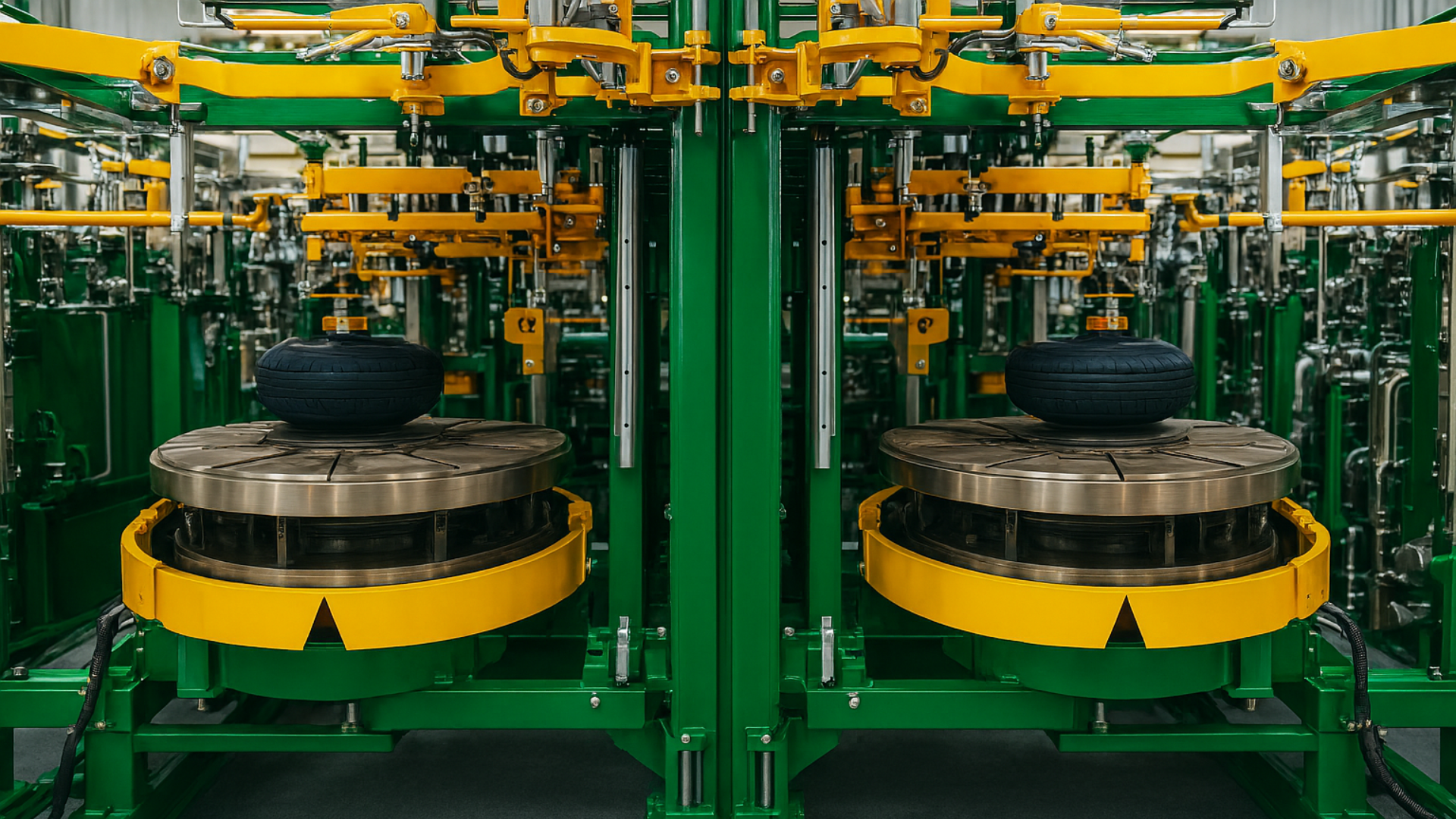
Vulcanization is a critical process in rubber product manufacturing that fundamentally enhances raw rubber by transforming it into a usable engineering material. By precisely controlling temperature, pressure, and time, vulcanization cross-links rubber's chain-like molecules into a stable three-dimensional network. This molecular transformation provides rubber products with superior properties such as high elasticity, mechanical strength, durability, and wear resistance
A curing machine (vulcanizing press) is the specialized industrial equipment designed to carry out this process under controlled conditions.
Working Principle of the Curing Machine
The operating principle of a curing machine is based on applying accurate and stable pressure and temperature to semi-finished rubber materials within a closed mold cavity for a defined period. This controlled environment allows the vulcanization reaction to fully complete and ensures consistent product quality.
Typical Working Steps of a Curing Machine
1. Loading and Mold Closing
Pre-mixed semi-finished rubber materials are placed into the mold cavity of the curing machine. The press power system—typically driven by a hydraulic cylinder—moves the upper platen downward to close tightly against the lower platen. This action creates a sealed, pressurized mold cavity with a defined shape.
2. Simultaneous Heating and Pressurization
Once the mold is closed, the curing process begins with the simultaneous application of heat and pressure.
-
Heating:
Heat is supplied through electric heating elements or steam circulating within heated platens. The platens transfer thermal energy to the mold, rapidly raising the rubber temperature to the required vulcanization range (typically 150 °C to 200 °C).
-
Pressurization:
The hydraulic system applies continuous clamping force to keep the mold closed during heating. This pressure performs two essential functions:
-
Ensures the rubber compound flows evenly and fills every mold cavity, achieving precise shape and surface definition.
-
Suppresses bubbles caused by trapped gas or moisture, ensuring high density and defect-free rubber products.
-
3. Pressure Holding and Vulcanization Phase
The curing machine maintains constant pressure and temperature for a precisely defined duration, known as the vulcanization time. During this phase, rubber molecules complete their cross-linking reaction and develop their final mechanical and physical properties.
4. Mold Opening and Product Unloading
After the vulcanization cycle is complete, hydraulic pressure is released and the upper platen moves upward to open the mold. Finished rubber products are then removed manually or by automated handling systems.
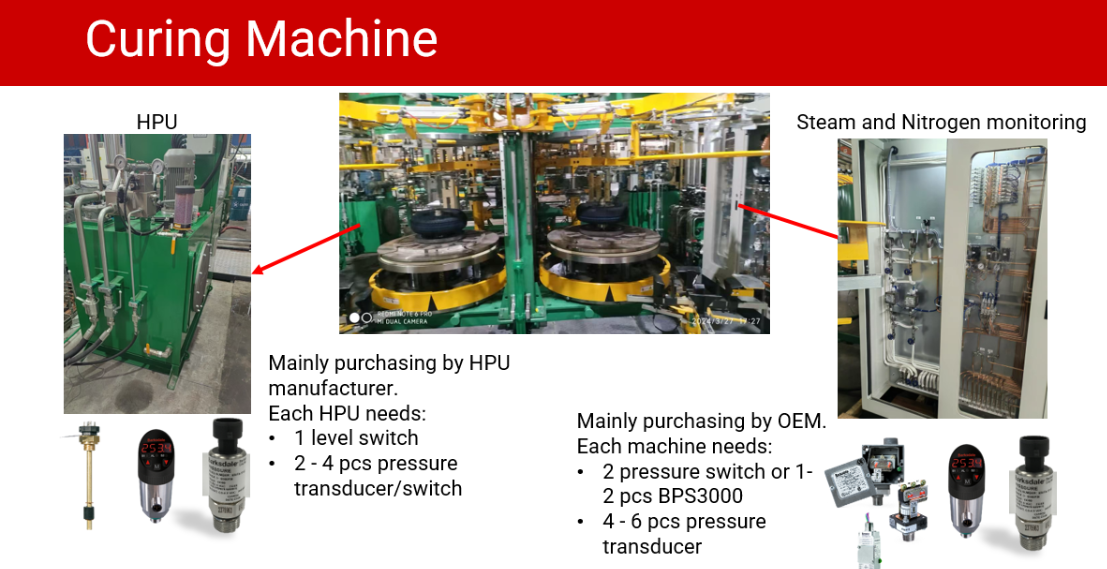
Application of Pressure Switches in Curing Machines
Pressure is one of the most critical parameters in vulcanizing press operation. Pressure switches play a vital role in process automation, safety protection, and product quality consistency.
Their application in curing machines can be divided into two primary functions.
1. Automatic Process Control and Safety Protection
In a curing machine, the pressure switch acts as a reliable pressure monitoring and control device throughout the operating cycle.
During mold closing, hydraulic pressure gradually increases. A pressure switch is set to a predefined minimum operating pressure. When this pressure is reached, the switch activates and sends a signal to the control system (such as a PLC), confirming that sufficient mold-clamping force has been achieved. Only then does the system initiate the heating and timing sequence. This interlock prevents vulcanization from starting under insufficient pressure, reducing scrap and ensuring consistent quality.
Pressure switches also provide overpressure protection. A second setpoint can be configured as a maximum safety pressure. If abnormal conditions—such as valve failure or control system malfunction—cause the hydraulic pressure to exceed safe limits, the pressure switch reacts immediately by:
-
Shutting down the hydraulic pump or activating the pressure relief mechanism
This rapid response protects molds, hydraulic components, and personnel from damage caused by excessive pressure.
2. Direct Monitoring of Process Media
Pressure switches are also used to monitor process media directly involved in vulcanization.
-
Nitrogen Pressure Monitoring:
In tire vulcanization, nitrogen is commonly used as an internal pressure medium inside bladders or tire blanks. Pressure switches ensure nitrogen pressure remains within a safe operating range.
-
Low pressure triggers alarms or stops the curing cycle to prevent deformation or under-cured products.
-
Excessive pressure activates safety responses, protecting bladders and molds from rupture.
-
-
Steam Pressure Monitoring:
For steam-heated curing machines, pressure switches continuously monitor the steam supply pressure. Stable steam pressure is essential for accurate temperature control of heated platens. In addition to process regulation, the pressure switch serves as a critical safety device, automatically shutting down the system or issuing alarms when steam pressure exceeds allowable limits.
Why We Won: The Barksdale Advantage
In a competitive market against WIKA, JUMO, and Gefran, Barksdale was selected for three key reasons:
-
Extreme Durability (High Cycle Life): Vulcanizing is a high-volume, repetitive process. Barksdale’s heavy-duty piston and diaphragm designs are engineered to handle millions of cycles and the "hydraulic shock" of press closures without losing calibration.
-
Environmental Resilience: Curing environments are harsh, with high heat and chemical vapors. Our sensors (such as the BPS3000 and Series 423/425) offer superior thermal stability and protection compared to standard industrial alternatives.
-
Process Accuracy & Safety: By providing both discrete switching for safety and analog sensing for continuous PLC data, Barksdale offered a complete control loop. This reduced scrap rates and significantly improved the manufacturer's overall equipment effectiveness (OEE).
Check Out our Datasheets:
Level Switch- UNS1000
Electronic Dual Pressure Switch- BPS3000
Pressure Transducer- BoT Series